

GELO.AI GUIDE · SHOPIFY CONTENT · 2026
8 Before-and-After Rewrites for Shopify Stores
A practical guide to more specific, buyer-focused product copy—with examples for vintage, wall art, party supplies, fashion, home decor, jewelry and resale.
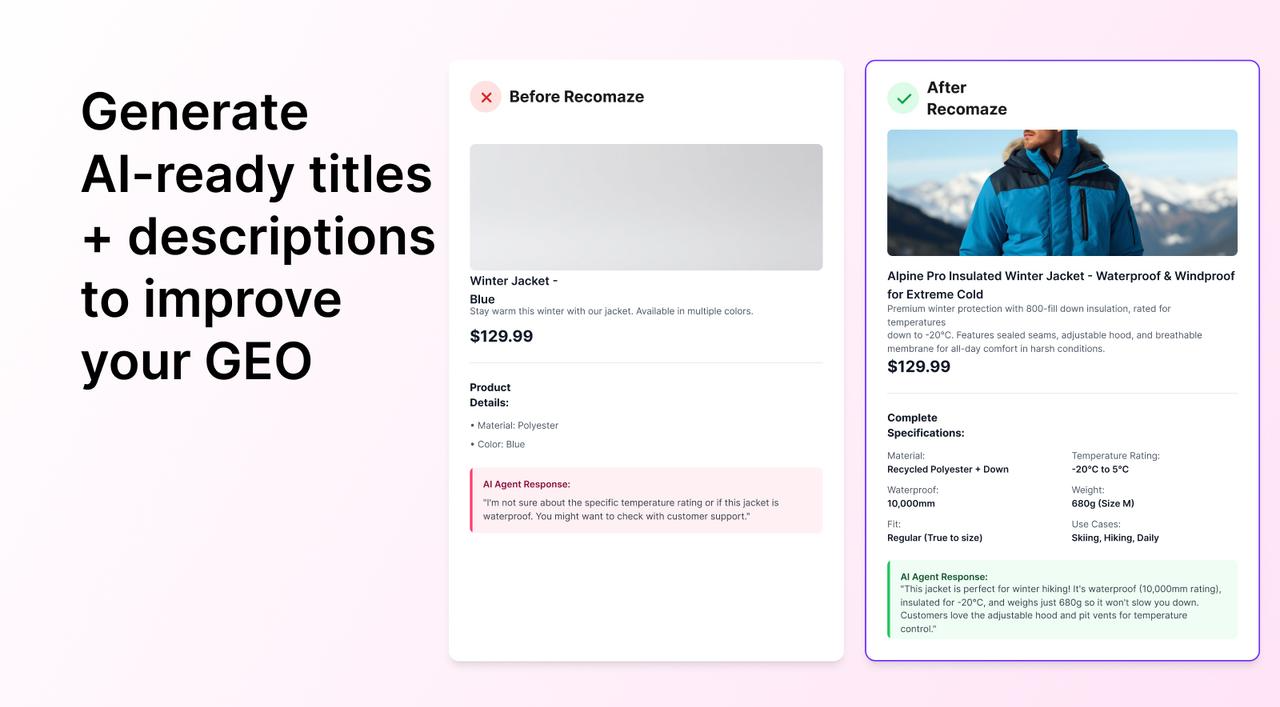
A product photo catches attention. A useful product description helps a shopper decide whether the item is right for them.
But there is a big difference between naming what is in a photo and explaining why that detail matters to a customer. “Green wall art” tells shoppers almost nothing. A description that explains the design, format, dimensions, and where the piece could fit helps them picture it in their space.
If you manage a Shopify store with dozens—or hundreds—of listings, this distinction becomes even more important. You need descriptions that sound human, stay factual, and can be created consistently across your catalog.
Below are eight illustrative before-and-after product description examples, a simple copywriting framework, and a reusable template you can adapt to your store. The examples are demonstrations, not customer case studies or measured conversion results. Product specifications in real listings must be verified before publishing.
What makes a product description persuasive?
A strong description does three things:
- Identifies the product clearly. What exactly is the shopper looking at?
- Connects relevant details to a real use. Why should a particular buyer care about those features?
- Removes uncertainty. What does the shopper still need to know about size, materials, condition, fit, quantity, or compatibility?
These are also the foundations of useful SEO content. Clear product names, natural category terms, and factual attributes help people—and search systems—understand the item without repetitive keyword stuffing.
Shopify’s guide to writing product descriptions that sell offers a helpful foundation for buyer-focused copy. Here, we’re applying that principle to image-heavy Shopify catalogs, where the challenge is creating distinct descriptions for many visually different products.
8 before-and-after product description examples
1. Vintage and second-hand: a brass-tone desk lamp
Before: Vintage lamp. Good condition. Nice for home or office.
After: Add warm character to your desk or reading corner with this pre-owned brass-tone desk lamp. Its curved arm and compact base bring a classic look to smaller spaces. Visible surface marks are part of the piece’s existing condition; review the close-up photos to decide whether the finish suits your style.
Why it is stronger: It names visible design details, gives a use case, and treats condition as information—not something to hide. Avoid calling an item “antique,” naming a designer, or asserting a metal composition unless you have proof.
2. Posters and wall art: a botanical print
Before: Green botanical poster. Great wall decoration.
After: Bring a calm, botanical accent to a gallery wall with this sage-green leaf illustration. Its soft palette works well with neutral interiors and natural textures. Check the listed dimensions and framing options before ordering so you can choose the right fit for your space.
Why it is stronger: It helps the shopper picture placement while clearly directing them to the verified size and format. It does not invent paper quality, printing methods, or frame inclusion.
3. Balloons and party supplies: a pastel garland kit
Before: Pretty pastel balloons for birthdays and parties.
After: Create a soft, colorful backdrop for a birthday table, baby shower, or photo corner with this pastel balloon garland kit. The coordinated shades make it easy to plan a cohesive party look. Before checkout, review the pack contents, balloon sizes, and assembly supplies included so you know exactly what you are getting.
Why it is stronger: The copy describes an event-focused benefit without claiming that hooks, glue dots, pumps, or exact quantities are included when they have not been verified.
4. Fashion and apparel: a relaxed button-up shirt
Before: Women’s shirt. Stylish and comfortable.
After: An easy-to-style button-up shirt with a relaxed silhouette, long sleeves, and a clean collar. Wear it open over a simple top or buttoned for a more polished look. Review the garment measurements and fabric composition to choose the fit and feel you prefer.
Why it is stronger: It replaces generic adjectives with observable features and outfit ideas. It does not assume breathability, softness, or fiber content from an image alone.
5. Home decor: a textured ceramic-style vase
Before: White vase for flowers. Beautiful quality.
After: A softly textured, off-white vase brings a subtle sculptural detail to a shelf, console, or dining table. Its rounded shape and understated finish pair easily with minimalist and earthy decor. Refer to the dimensions and product details to confirm whether the vase is suitable for fresh flowers or decorative stems.
Why it is stronger: It adds visual context and surfaces an important buyer question—water suitability—rather than making an unsupported claim.
6. Jewelry and accessories: a pendant necklace
Before: Gold necklace. Perfect gift for everyone.
After: A delicate pendant necklace with a warm gold-tone finish and a simple silhouette suited to everyday styling. Wear it alone for a minimal look or layer it with other pieces. Check the chain length, material details, and care instructions before purchasing.
Why it is stronger: It is specific about appearance and styling while avoiding unverified claims such as solid gold, hypoallergenic, or tarnish-proof.
7. Resale products: pre-owned white sneakers
Before: Used white sneakers. Great deal. Like new.
After: Pre-owned white low-top sneakers with a clean, versatile shape that pairs easily with casual outfits. The photographs show visible creasing and signs of wear, so review each angle and the condition notes before ordering. Confirm the tagged size and any seller-provided measurements for fit.
Why it is stronger: Honest condition language builds confidence. “Like new” should not appear unless the actual condition supports it; authenticity and brand claims also require verification.
8. Print-on-demand: a mountain landscape poster
Before: Mountain poster, unique design, best wall art.
After: A sunrise mountain landscape illustration that adds a peaceful focal point to a bedroom, office, or reading nook. The layered peaks and warm sky colors complement both modern and cozy spaces. Choose from the available sizes and review the product’s print and framing details before purchasing.
Why it is stronger: It describes what makes the artwork visually distinctive and gives a natural next step, without claiming limited-edition status or superior print quality.
The 3-part description formula you can reuse
For most visual Shopify products, start with this structure:
1. Identify: Product name + the most distinctive verified detail.
2. Connect: One or two ways the detail helps the buyer, complements a setting, or answers a practical need.
3. Clarify: The attributes the buyer must confirm—dimensions, materials, variants, what’s included, fit, condition, or care.
Example: “This [product type] features [verified distinguishing detail]. It works well for [realistic use case] and pairs with [relevant style or situation]. Check [important specifications] before ordering.”
Not every product needs a long story. For many items, one specific introductory paragraph followed by a few scannable bullets is enough. Technical or high-consideration purchases may need more detail.
A copy-and-use Shopify product description template
Product name: [Clear product name, including a meaningful distinguishing term]
Opening: [What the product is] with [verified feature] for [relevant use or audience].
Why it matters: [Explain the feature’s practical or aesthetic benefit without promising an unverified outcome.]
Key details:
- [Verified size or dimensions]
- [Verified material or finish]
- [Color, pattern, and variant details]
- [Condition, compatibility, or included items where relevant]
Before you order: [One important fit, setup, care, or condition note.]
Next step: [Natural shopping CTA, such as “Choose your size” or “Explore the available colors.”]
For SEO, use the main product term naturally in the title or opening and write each listing around what actually makes that item different. Avoid pasting the same paragraph onto every product page.
How Pics to Description helps when you manage many listings
Writing one thoughtful description is manageable. Writing a different, accurate description for every wall art design, vintage find, party kit, or apparel variant is where the workload grows.
Pics to Description by Gelo.ai is designed for this part of the workflow. The Shopify app uses AI image analysis to help generate product descriptions and SEO metadata, supports reusable Custom Instructions for your store’s voice, and offers bulk generation for larger catalogs.
The practical process is:
- Select the Shopify products and images you want to work on.
- Use Custom Instructions to define your audience, voice, format, and important product details.
- Generate descriptions and relevant SEO metadata.
- Review each result against the actual images and verified product information.
- Make corrections and use the content in your store.
Your product knowledge still matters. An image can reveal shape, color, visible text, and style; it cannot always confirm dimensions, exact materials, technical specifications, provenance, or authenticity.
Example Custom Instruction for visual catalogs
“Write for a Shopify store selling [category]. Use a clear, friendly, helpful tone. Begin by identifying the product and its most distinctive visible features. Connect those details to one realistic buyer benefit or use case. Use short paragraphs and concise bullet points where useful. Include verified attributes from the product data. Do not invent dimensions, composition, certifications, authenticity, quantities, condition, performance claims, or included accessories. If a detail cannot be verified, leave it out. Avoid clichés, exaggerated superlatives, and keyword stuffing. End with a natural next step relevant to the product.”
Start with a small batch of listings, refine your instructions, and review the results before applying them to more products. For a broader introduction, read our existing article on using AI to create high-converting product descriptions for Shopify.
The 5-point product description audit
Before updating or publishing a listing, score each question 0 or 1:
- Clarity: Can a shopper identify the product in the first sentence?
- Specificity: Does the copy mention real details instead of “amazing” or “high quality”?
- Buyer relevance: Does it explain a realistic use, benefit, or reason to consider the item?
- Accuracy: Are materials, size, condition, contents, and claims verified?
- Scanability: Can a mobile shopper find the most important information quickly?
0–2 points: Rewrite the description. 3–4 points: Improve the weakest area. 5 points: Ready for a final product-fact check and testing.
This is a practical editorial checklist, not a scientific conversion score. Use actual store analytics to evaluate whether changes help visitors engage, add products to cart, or buy.
How to tell whether your product descriptions are working
Changing your descriptions does not guarantee more sales or higher rankings. To evaluate an update, record the date and watch signals such as product-page engagement, add-to-cart rate, conversion rate, organic search clicks, customer questions, and returns that may reflect unclear expectations.
Compare similar products or time periods carefully. Traffic source, promotions, price, seasonality, and inventory can also influence results. If your store has enough traffic, consider controlled testing rather than assuming that the newer copy caused a change.
Final takeaway: write for shoppers first, then scale the workflow
The best product descriptions are not always the longest or the most imaginative. They’re the ones that tell the right shopper exactly what matters about the product.
Start with a clear product identity, connect distinctive details to genuine buyer value, and remove uncertainty. Then build a repeatable process so your listings stay consistent as your catalog grows.
Want to turn product images into clearer Shopify product content? Explore Pics to Description in the Shopify App Store or visit Gelo.ai to see how AI image analysis, Custom Instructions, and bulk generation can support your workflow.
Frequently asked questions
How do I write a product description that sells?
Identify the product clearly, explain relevant benefits, provide verified details, and answer likely buyer questions. Use concise paragraphs and scannable formatting, then test performance with your own store data.
How long should a Shopify product description be?
Long enough to help a shopper make a confident decision and no longer. Simple products may need only a short paragraph and bullets; complex purchases may need specifications, instructions, and FAQs.
Can AI write product descriptions from photos?
Yes. Image-aware AI tools can use visible characteristics and product information to draft descriptions. Review the result carefully because a photo alone cannot reliably establish every important product fact.
Should I use the same template for every Shopify product?
Use a consistent structure, but customize the details for each product. Reusing identical generic copy across many product pages makes the listings less useful to shoppers.
Do better descriptions guarantee more sales or SEO traffic?
No. Descriptions can help shoppers understand products and give search engines useful context, but outcomes depend on many factors, including traffic quality, price, product demand, site experience, and competition.

Leave a Reply